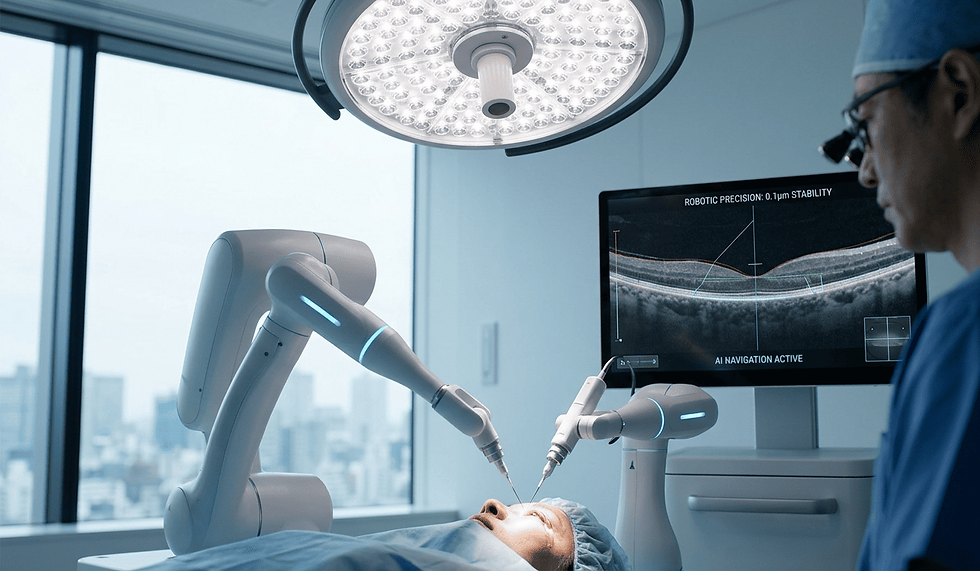
Light Adjustable Lens (LAL) Cataract Surgery: The Precision of Post-Operative Refinement in Japan

I. Introduction: Defining the Next Generation: Why LAL Revolutionizes Cataract Surgery
Cataract surgery is remarkably successful, yet it faces a persistent challenge: achieving perfect refractive accuracy is difficult due to subtle, unpredictable variations in healing and pre-operative measurements. The Light Adjustable Lens (LAL), pioneered by RxSight, represents the next generation of Intraocular Lenses (IOLs) because it fundamentally resolves this issue.
The LAL is the only IOL that allows the surgeon to non-invasively adjust the lens power after the surgery and healing are complete. This eliminates the risk of a "refractive surprise"—the slight, unexpected residual prescription. This article explores the unique mechanism and profound advantages of lal light adjustable lens cataract surgery, emphasizing why its precision and meticulous follow-up requirements make it an ideal fit for the rigorous standards of Japanese ophthalmology.
II. The LAL Mechanism
The LAL technology is rooted in photochemistry, providing a level of precision that was previously impossible.
1. The Core Technology: The LAL is crafted from a unique photosensitive silicone material. Embedded within the lens are specialized macromers (light-absorbing molecules). When exposed to a specific, low-level UV light delivered by a dedicated adjustment system, these macromers migrate and polymerize, causing a controlled and permanent change in the lens's curvature and, thus, its refractive power.
2. The Adjustment Process: The LAL process involves three distinct phases:
Insertion: The LAL is implanted into the eye, just like a standard IOL.
Healing & Observation: The patient is allowed to heal for a period (typically 2-3 weeks). During this time, the eye stabilizes, and the final refractive error is precisely measured.
Adjustment Sessions: The patient returns for several outpatient adjustment sessions where the surgeon applies the UV light to fine-tune the lens power to near-perfect accuracy, addressing any residual prescription error.
III. The Safety Rationale
The greatest safety challenge in cataract and refractive surgery is prediction error. LAL addresses this challenge directly.
1. The Challenge of Biometry: Traditional IOL calculation formulas, despite being highly advanced, must rely on pre-operative measurements and assumptions. Healing variability, slight errors in eye length (axial length) measurement, and anatomical changes mean a small refractive error is almost always possible.
2. LAL Solution: Certainty in Vision Correction: The LAL eliminates this uncertainty. It shifts the primary corrective step from pre-operative prediction to post-operative verification. The surgeon measures the actual, stable refractive outcome of the healed eye and adjusts the lens to that exact number. This capacity to eliminate refractive surprise is a profound advantage for patient satisfaction and long-term visual quality.
IV. Applications and Indication
While LAL offers benefits to all cataract patients, it provides a crucial solution for complex cases where predictability is low.
1. Primary Candidates: LAL is ideally suited for patients seeking the highest possible level of post-operative refractive accuracy—patients with demanding visual needs, or those with anatomical irregularities that make conventional IOL calculation difficult (e.g., unusually long or short eyes).
2. Post-Refractive Eyes (LASIK/PRK): LAL offers its most significant clinical advantage for patients undergoing cataract surgery after LASIK or PRK. Laser surgery fundamentally alters the corneal curvature, making standard IOL power calculation highly unpredictable. LAL bypasses this prediction failure entirely by allowing the surgeon to correct the residual error based on the stable, post-operative outcome.
V. The Procedure and Post-Op
The LAL process requires specific patient compliance for safety and efficacy.
1. Surgical Procedure: The implantation of the LAL is identical to standard cataract surgery (phacoemulsification) and takes minutes to perform.
2. Post-Op Care and UV Protection: LAL’s unique feature necessitates a special post-operative instruction: Patients must wear UV-blocking glasses full-time (indoors and outdoors) until the final power lock-in is complete. Exposure to uncontrolled UV light during this period can unintentionally and prematurely alter the lens power.
3. Final Lock-In: Once the refractive error is perfectly tuned (typically after 1-3 adjustment sessions over several weeks), the surgeon performs a final UV light treatment that locks the lens power permanently, making it insensitive to future UV exposure.
VI. The Japanese Advantage in LAL Adoption
The successful application of lal light adjustable lens cataract surgery requires the perfect fusion of advanced diagnostics, micro-surgical skill, and meticulous long-term follow-up—all hallmarks of Japanese ophthalmic care.
1. Precision Biometry and Complex Case Management: Japanese centers actively adopt LAL, particularly due to the high volume of complex post-refractive cases. Their expertise in advanced biometry ensures that even the initial IOL power is calculated with the highest possible accuracy. This commitment to precision provides the ideal starting point for the final fine-tuning phase.
2. Meticulous Follow-up for Adjustment: The LAL process requires multiple, highly accurate adjustment sessions and unwavering patient compliance regarding UV protection. The structured, detail-oriented medical system in Japan is perfectly suited to support this meticulous follow-up schedule, ensuring that the adjustment process is accurate, safe, and completed without compromise.
VII. Conclusion: The Future of Prediction: Certainty in Vision Correction
The lal light adjustable lens cataract surgery fundamentally changes the predictability of vision correction. It transforms cataract surgery from a procedure reliant on prediction into one defined by certainty.
For patients seeking the absolute best post-operative outcome, especially those with unique anatomical challenges or previous surgeries (like LASIK), the LAL is the definitive choice. By combining this revolutionary lens with the precision diagnostics and meticulous care inherent in Japanese ophthalmology, patients can be assured of achieving their best possible vision with unparalleled refractive accuracy.
This article was reviewed
Dr. Daiki Sakai, MD