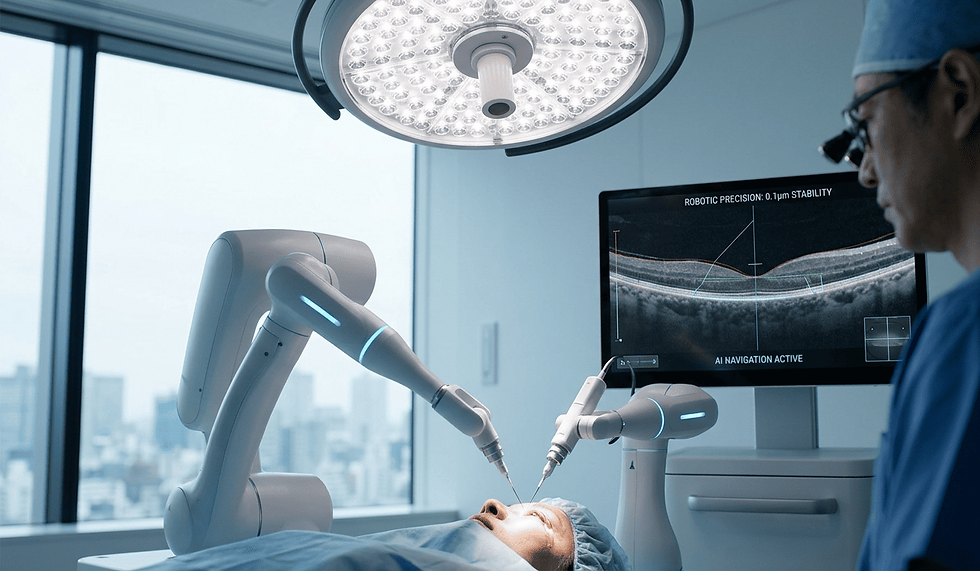
Uncompromising Precision: Why Japan's Ophthalmology Surgery Success Rates Lead the World
Updated: Apr 23
1. Why Japan is the Global Gold Standard for Eye Care
Ophthalmology is a field of modern medicine that demands an extraordinary level of delicacy and precision.
In the pursuit of preserving visual function, Japan has established a global reputation for excellence through consistent clinical standards and superior technical expertise.
The high success rate of treatment in Japan is driven by a unique synergy: the fusion of refined surgical skill and advanced medical technology.
From routine cataract surgeries to complex retinal detachment repairs, clinical practice consistently prioritizes the minimization of risk and the optimization of visual quality.
Through specialist education, state-of-the-art facilities, and a deep-rooted commitment to preventive medicine, Japan delivers clinical outcomes that rank among the best in the world.
2. Microsurgery Designed to Minimize Complication Risks
Cataract surgery in Japan is one of the safest medical options available globally.
Japanese ophthalmologists undergo world-class training in "microsurgery," performing precise operations within an incredibly narrow surgical field.
A key global metric for evaluating the quality of cataract surgery is the incidence rate of "Posterior Capsule Rupture" (PCR).
This occurs when the thin membrane supporting the lens is damaged during surgery, and its frequency directly reflects the surgeon's skill level and the safety of the procedure.
In the ophthalmic community, keeping this rate low is considered a critical mission, as it dictates the quality of postoperative vision recovery.
According to a 2020 survey, Japan's PCR incidence rate stands at a remarkably low 0.6% (1).
Driven by a decade of technological innovation and device evolution, Japan's surgical precision has improved dramatically.
This performance is equal to the data from leading medical institutions in Europe and the United States.
This philosophy of "eliminating complications to the absolute limit" is the foundation of the world's trust in Japanese ophthalmology.

3. Minimally Invasive Glaucoma Surgery (MIGS): Reducing the Burden on Your Eye
Japan is a global leader in MIGS—a patient-friendly approach to glaucoma treatment.
Currently, Japan stands as a frontrunner for MIGS in Asia.
According to 2023 data from the Ministry of Health, Labour and Welfare, the annual number of MIGS procedures reached 32,970 (2), making it the second most prevalent in the region after Singapore.
Notably, the "Microhook ab interno LOT (µLOT)" using the Tanito Hook (3)—a surgical procedure developed by Professor Masaki Tanito of Shimane University—has gained global recognition and is performed on patients worldwide.
By controlling intraocular pressure through incisions of only a few millimeters, this technique minimizes tissue damage and allows for fast postoperative recovery.
4. Fusing Craftsmanship and Advanced Tech to Combat Intractable Retinal Diseases
The true prowess of Japanese retinal surgeons is most evident in difficult, high-stakes cases.
For serious conditions that can lead directly to blindness, such as retinal detachment or macular holes, Japan's vitreoretinal surgery boasts world-class accuracy.
This precision is supported by a fusion of rapid device evolution and a uniquely Japanese "craftsmanship" that pushes these tools to their limits.
Modern vitrectomy systems now feature high-speed cutting (over 10,000 cuts per minute) and ultra-small incision surgery (25/27 gauge).
While these technologies are groundbreaking, they also raise the bar for the surgeon's skill.
Japanese surgeons do not just "operate" these devices; they combine them with the refined manual techniques for which Japan is famous.
This uncompromising approach—optimizing surgery time while minimizing ocular invasion—enables the preservation and restoration of sight even in complex cases deemed untreatable elsewhere.
5. ICL: The Next Generation Standard for Vision Correction
Japan is a global hub for ICL (Implantable Collamer Lens), a vision correction method that does not require thinning the cornea.
Japan boasts one of the highest volumes of ICL procedures in the world and is home to many manufacturer-certified "Expert Instructors."
Japanese doctors, utilizing advanced skills and experiences, adjust the lens fixation position with sub-millimeter accuracy.
This delicate calibration minimizes "halos and glares" (the phenomenon where light appears blurred or ringed in dark environments), ensuring a superior visual experience.

6. "AI Eye Docks": Protecting Your Vision with Predictive Medicine
Ophthalmic examinations in Japan have evolved into "predictive medicine."
By integrating world-renowned diagnostic imaging (such as OCT) with the latest AI analysis algorithms, abnormalities can be detected with extreme accuracy even in the early, asymptomatic stages.
The "Eye Dock" (comprehensive eye exam) goes beyond detecting glaucoma or age-related macular degeneration; it can even identify risks of stroke or cardiovascular disease through retinal blood vessel analysis.
For those proactive about their health, this is a preventive investment more valuable than surgery itself.
The system is designed to provide seamless coordination with top domestic specialists immediately upon diagnosis.
Early detection remains the most critical factor in ensuring high surgical success rates.
7. Your Vision, Reborn in Japan
Investing in Japanese ophthalmic care is more than choosing a treatment—it is an investment in your lifelong Quality of Life (QOL).
Beyond the "Surgeon's Craftsmanship," Japan offers a unique medical experience that blends cutting-edge facilities with the spirit of Omotenashi (Japanese hospitality).
From highly personalized diagnostics to recovery suites designed for privacy and comfort, every step of the process is meticulously managed.
Choosing Japan means choosing the "most reliable path" to protect your view of the world.

References
Sato, M. et al. 2020 JSCRS Clinical Survey. IOL & RS, 34: 412-432, 2020.
The 10th NDB Open Data (National Database of Health Insurance Claims and Specific Health Checkups of Japan).
Tanito M, et al. Microhook ab interno trabeculotomy, a novel minimally invasive glaucoma surgery, in eyes with open-angle glaucoma with scleral thinning. Acta Ophthalmol 2016;94(5):e371-e372.
About the Author
Daiki Sakai, MD, PhD
Japanese Board-certified Ophthalmologist
Founder, Ophthoagent Team