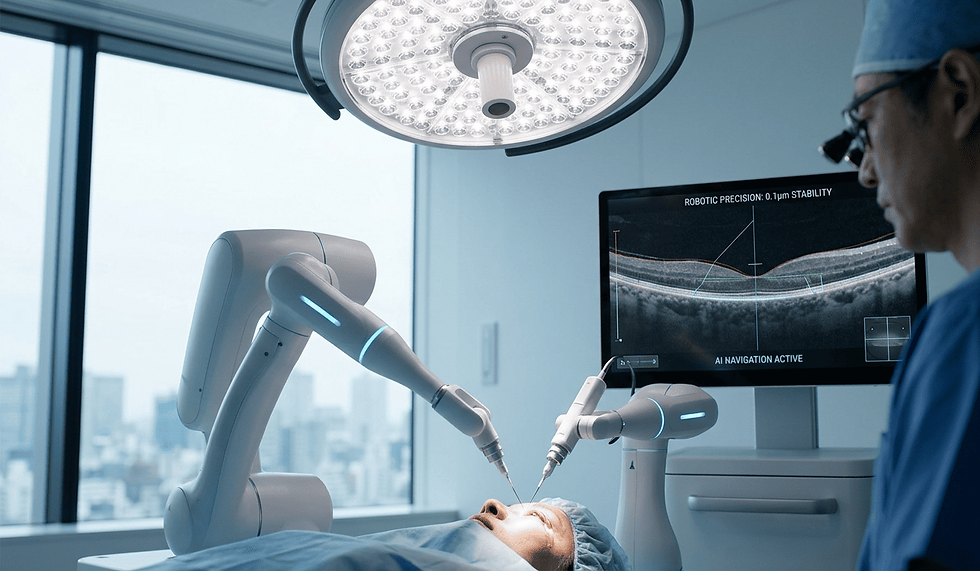
Cataract Surgery After LASIK: Precision IOL Calculation and the Japanese Expertise in Post-Refractive Eyes

I. Introduction: The Post-Refractive Challenge: Cataract Surgery After LASIK
As the population ages, an increasing number of individuals who underwent LASIK or other corneal refractive procedures decades ago are now developing cataracts. The necessity of undergoing cataract surgery after LASIK presents a significant challenge to even the most skilled ophthalmologists. LASIK’s primary function—to permanently change the curvature of the cornea—fundamentally alters the eye's refractive power, making the accurate calculation of the new Intraocular Lens (IOL) power exceptionally difficult.
This complexity transforms a routine procedure into a highly specialized one. This article addresses the core problems of IOL calculation in post-LASIK eyes and details why the diagnostic precision and surgical expertise found in Japanese ophthalmology are crucial for achieving the predictable, high-quality visual results patients expect.
II. The Core Problem: Why IOL Calculation is Difficult After LASIK?
Standard cataract surgery relies on highly accurate formulas to predict the correct IOL power based on pre-operative corneal curvature and axial length (eye length). LASIK compromises this process in two primary ways:
1. Central Problem (The Two Errors): LASIK leads to two main sources of error when using standard IOL formulas:
Error 1: Keratometry Error (Misleading Measurements): Post-LASIK corneas often have a flatter central curvature. Standard devices (keratometers) used to measure corneal power misinterpret this flatter front surface, causing the surgeon to underestimate the true refractive power of the cornea.
Error 2: Formula Error (Assumption Failure): Traditional IOL formulas rely on the fixed mathematical relationship between the front and back corneal surfaces (known as the ratio). LASIK changes this ratio, causing the formula to predict the wrong IOL power.
2. Standard Formulas Fail: Because of these two compounded errors, using a standard IOL formula in a post-LASIK eye results in a high probability of a refractive surprise—meaning the patient will be left with a significant, unexpected post-operative refractive error, usually farsightedness (hyperopia).
III. Precision Diagnostics Solution in Japan
The path to accurate IOL calculation in post-LASIK eyes begins with overcoming measurement errors. Japanese clinics prioritize the use of specialized diagnostics and historical data to achieve this precision.
1. Advanced Topography and Tomography: Accurate measurement of the altered corneal shape is non-negotiable. Japanese specialists utilize the latest generation of diagnostic imaging tools—such as the Pentacam or Galilei—which use Scheimpflug technology to provide three-dimensional measurements of both the anterior and posterior surfaces of the cornea. This allows the surgeon to determine the true, total corneal power more accurately than reliance on the front surface alone.
2. Historical Data is Key: The single most valuable piece of information for accurate calculation is the patient's pre-LASIK corneal curvature (K readings) and the post-LASIK manifest refraction. Japanese specialists meticulously seek to acquire this historical data, as it allows them to calculate the exact tissue removal and apply formulas based on the actual change. This ability to access and utilize historical records significantly enhances prediction accuracy.
3. IOL Master and Biometry: While the challenge lies in the cornea, accurate axial length measurement is still required. Utilizing high-precision optical biometry devices (like the IOL Master or similar advanced OCT-based biometers) ensures that the non-corneal measurements are flawless.
IV. Advanced Calculation Methods
Because no single IOL calculation method is flawless for post-LASIK eyes, the Japanese approach relies on cross-checking results using the most advanced formulas specifically designed for post-refractive eyes.
1. Specific Formulas: Specialized formulas have been developed to bypass the two measurement errors inherent in traditional methods. Japanese surgeons are highly proficient in using these advanced techniques, which often include:
The Barrett True-K Formula: One of the most accurate modern formulas that uses the patient's history or a regression analysis method to estimate the true corneal power.
The Haigis-L Formula: Designed to adjust the calculation based on the amount of spherical aberration induced by the laser procedure.
2. The Online Calculator Advantage: Expert surgeons utilize advanced online calculators and web-based resources provided by international societies. These tools allow the surgeon to input all available data (historical K's, current K's, etc.) and generate a consensus result from multiple formulas. The final IOL power chosen is based on the consensus of these highly precise calculations, minimizing the chance of a refractive surprise.
V. Surgical Planning and IOL Choice
The complexity of the IOL calculation directly impacts the safety and suitability of the lens choice.
1. Monofocal vs. Multifocal: In post-LASIK eyes, the cornea often has increased aberrations (irregularities) that can exacerbate light-scattering phenomena. Therefore, the use of multifocal or trifocal IOLs, which already carry a risk of halos and glare, is often approached with heightened caution. The Japanese standard emphasizes monofocal IOLs for maximal predictability, or EDOF IOLs, which often have better aberration tolerance, unless the patient has a very low level of pre-existing corneal irregularity.
2. Toric IOLs: Residual astigmatism is common after LASIK. The use of a Toric IOL is essential to correct this, but the rotation and positioning must be absolutely perfect, requiring enhanced surgical precision.
3. Enhancement Option: Despite the best calculations, a slight residual refractive error may remain. Japanese specialists often plan for the possibility of a post-operative laser enhancement (a touch-up laser ablation on the cornea) to fine-tune the result and achieve the patient's target vision, provided a safe amount of corneal tissue remains.
VI. Conclusion: Guaranteeing Clarity: The Specialist’s Role in Complex Cases
The journey of cataract surgery after LASIK is not the same as routine cataract removal; it is a highly specialized task requiring mastery of advanced biometry and predictive formulas. The risk of significant refractive error post-surgery is real if traditional methods are used.
By choosing Japanese ophthalmic expertise, patients gain access to surgeons who are fluent in the most sophisticated calculation methods (Barrett, Haigis-L), utilize state-of-the-art diagnostic imaging, and adhere to a meticulous planning process. This specialized proficiency guarantees the highest possible level of predictability and visual quality in the face of post-refractive complexity.
This article was reviewed by
Dr. Daiki Sakai, MD